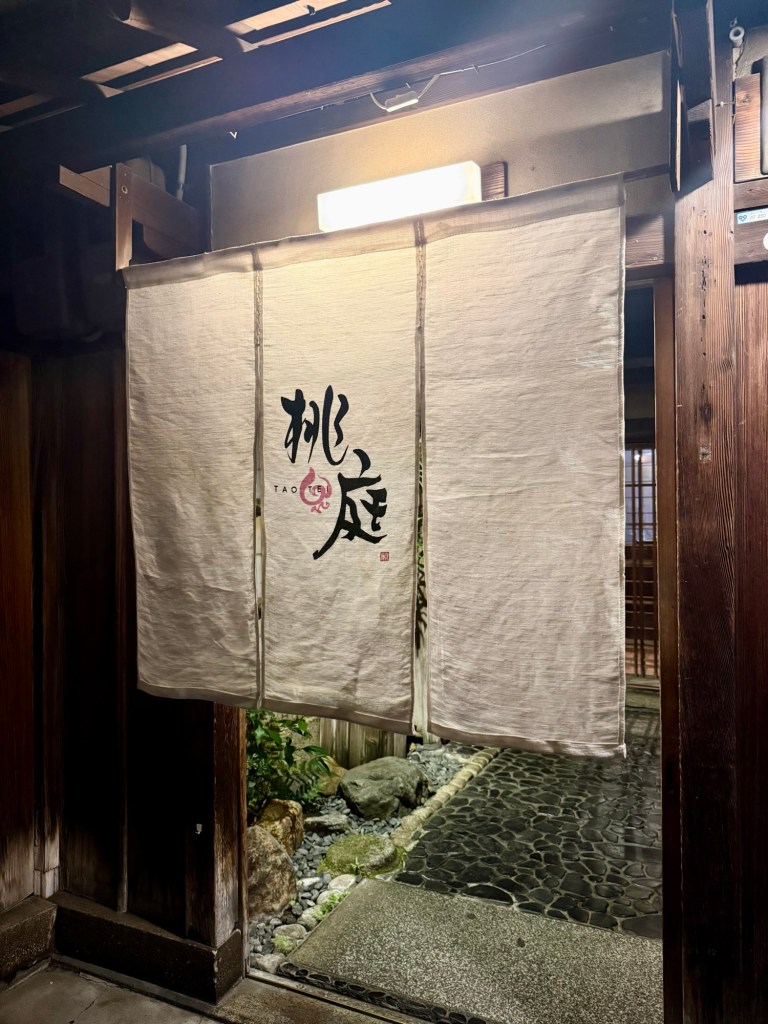
There was once a woman who walked the narrow streets of Kyoto not in search of places, but of thresholds.
She had come to understand that doors were too absolute—either open or closed, either permission or refusal. But the curtains… the curtains were different. They breathed.
She first noticed one at dusk, hanging in the quiet blue hour when lantern light begins to remember itself. The fabric was indigo, split gently down the middle, brushing the air as if it, too, hesitated to fully part.
She did not enter.
Instead, she stood before it and felt something ancient stir within her—not curiosity, but recognition. The curtain did not conceal. It revealed the nature of approach.
A voice—though no one spoke—seemed to whisper:
You are not meant to cross every threshold you encounter. Some exist only to show you how you arrive.
Days passed, and she began to seek them out—the noren of tea houses, of hidden restaurants, of places with no names. Each curtain was different: some weathered and frayed, whispering of long endurance; others crisp and new, still learning how to hold a boundary.
At one entrance, she reached out and touched the fabric.
It yielded, but did not open.
Instead, it pressed back—softly, but with unmistakable presence. Not a rejection, not an embrace. A question.
With what intention do you enter?
She withdrew her hand.
For the first time, she understood: the curtain was not guarding the space beyond. It was guarding the space within her that wished to cross without awareness.
So she began to practice.
At each noren, she paused. She listened—not to the sounds beyond, but to the movement within herself. Hunger, loneliness, curiosity, longing, escape. Each motive altered the weight of her hand as it approached the cloth.
Sometimes, she turned away.
Other times, she entered—but only when her presence felt aligned with the quiet dignity of the threshold.
Inside, nothing remarkable awaited her—tea, conversation, silence. Yet everything was different, because she had crossed consciously. The world did not change. She did.
One evening, she came upon a curtain unlike the others.
It was plain. Unmarked. Neither old nor new. It hung in a narrow alley where no footsteps lingered.
She knew immediately: this was not a place one stumbled upon. This was a place one was ready for.
Her breath slowed.
She approached, but the familiar ritual faltered. For when she listened inward, she found not a single intention—but many, layered and conflicting. Desire and fear intertwined. A longing not to enter a place, but to be seen. To be known. To be undone.
The curtain moved slightly, though no wind passed.
And then she understood.
This noren was not guarding a room.
It was guarding a transformation.
To pass through would mean relinquishing the illusion that she could curate how she was received on the other side. It would require her to step through as she was—uncomposed, unprotected, unhidden.
Her hand trembled.
For a long while, she stood there—at the seam between who she had been and who she might become.
Then, with a quiet resolve, she did something unexpected.
She did not part the curtain.
She bowed.
And in that gesture—an honoring of the threshold without the need to cross—it parted on its own.
Not dramatically. Not even visibly. But something within her shifted, and she found herself already inside.
There was no room.
No tea.
No host.
Only a vast, luminous stillness, as if she had entered the interior of her own awareness—unveiled.
And there, she realized:
The noren had never been a barrier.
It was a teacher.
A living symbol of sacred restraint—that not all crossings require movement, and not all entrances are made with the body.
Some are made with presence.
Some with reverence.
And some… only when one no longer needs to pass through at all.



Any comment or thoughts share them below.