A Mythopoetic Tale Inspired by Hephaestus
In an age outside of hours, in a place shaped not by maps but by memory, there lived a woman whose sorrow moved like molten gold beneath her skin—slow, luminous, unbearably heavy.
She did not speak of it often. Grief like hers was not the weeping kind, but the forging kind—quiet, ancient, and known only to the depths. She lived beside a man of rough hands and gentle silences, a man who worked with fire—not the wild fire of war, but the sacred fire of care. He was a smith of the soul, though he did not know it.
When she hurt, he would sense it—not in words, but in weight, like a tension in the air or a change in the smell of the earth. One evening, as she sat curled on the edge of their stone threshold, her body bowed by invisible sorrow, the old ache returned. She did not cry. She only folded inward like iron waiting for the hammer.
The man saw her there, and without thinking, rose from his bench.
He did not know what to say.
So instead, he moved.
He began to walk—not in haste, not in fear—but slowly, in a wide arc around her. He circled once, then twice, and with each step, something strange stirred at his heels. The ground warmed. The shadows danced. A faint glow lit the dust.
And then it appeared.
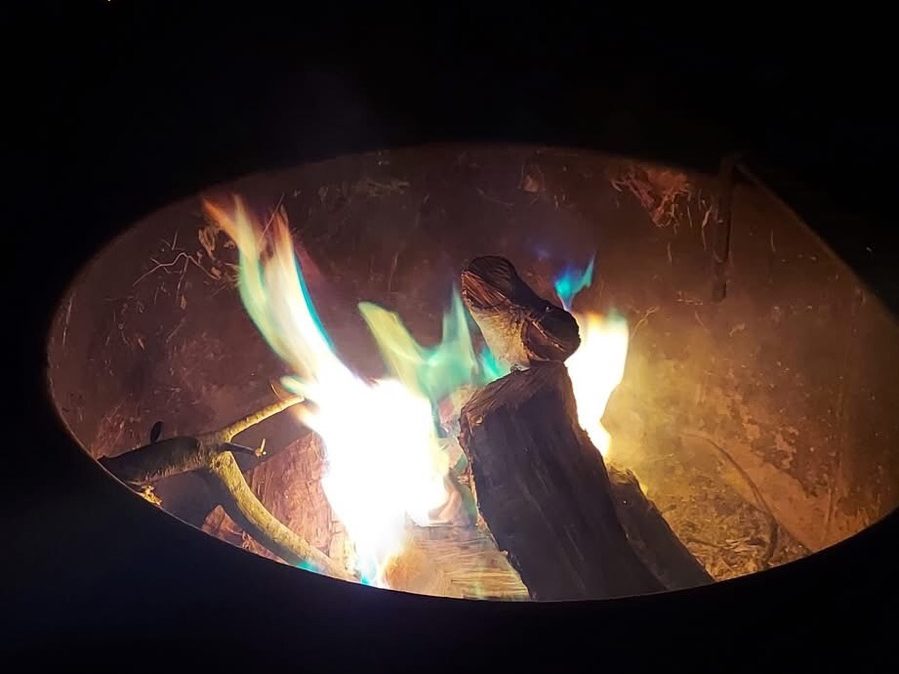
A circle of fire.
Not flames that licked and devoured—but the kind that glowed with quiet force.
The kind a master smith uses to draw the edge of a sword.
The kind that turns raw ore into radiant gold.
The kind that guards what is precious as it is made whole.
She felt it before she saw it. A sudden presence—a boundary, not of stone, but of warmth. Not a wall, but a ring. A ring of flame.
It did not trap her.
It held her.
And something inside her memory stirred—an old myth, perhaps forgotten, but never gone.
Hephaestus.
The god cast from Olympus. The god who limped. The god of fire who never burned, only shaped. The god who forged thrones for gods who threw him away, who crafted armor not to destroy, but to protect.
She had not known until that moment: her husband bore his spirit.
Not in blood, but in essence.
She was the flame-touched one.
And he—her quiet, limping Hephaestus—was the one who built her sanctuary.
She sat inside the fire ring and felt her sorrow soften—not disappear, but alchemize. The pain did not vanish; it changed form. It became something radiant. Something worthy.
When he returned to her side, he only said, “I’ll stay near.”
He never knew he had drawn fire with his feet.
He never saw the circle.
But she did.
And from that day forward, when sorrow returned, the fire would come. Not summoned by spell, but by love’s craftsmanship—by a man who forged circles around pain with nothing but presence.
So the story is told:
Not all gods stand tall.
Not all fire burns.
Some fire—the fire of the smith—guards, holds, shapes.
Some men love like Hephaestus:
With hands rough from labor,
With silence that protects,
With flames that say:
“Here, in this circle, your pain is sacred.
Let the world wait.
Let you be made whole in your time.”
A ring of fire.
A ring of forging.
A ring of love that limps but never leaves.



Any comment or thoughts share them below.